A MATLAB/Dynare toolkit for solving dynamic models with occasionally binding constraints easily — updated for Dynare 6.5 and Dynare 7.0.
Requires Dynare 6.5 or 7.0 | MATLAB R2026a | macOS ARM64 verified
Published paper
OccBin: A Toolkit to Solve Models with Occasionally Binding Constraints Easily
Luca Guerrieri & Matteo Iacoviello — Journal of Monetary Economics, Vol. 70 (2015), pp. 22–38 · doi:10.1016/j.jmoneco.2014.08.005
What it does
OccBin solves DSGE models in which one or two constraints bind occasionally — zero lower bounds, borrowing limits, irreversibility — without requiring global methods or perfect-foresight solvers. The algorithm pieces together regime-specific linear solutions, iterating until the sequence of binding periods is consistent.
Solves models that switch between a reference regime and one alternative regime, such as a zero lower bound on the nominal interest rate or an irreversibility constraint on investment.
Extends the algorithm to models with two simultaneously active
constraints — four possible regime combinations — using
solve_two_constraints_add_violvecbool.
Works with any model written as a pair of standard Dynare
.mod files: one for the unconstrained regime and one
for the binding regime. Variables and parameters must be declared
in the same order in both files.
Prerequisites
setpathdynare6_5.m before using any example
with Dynare 6.5; run setpathdynare7.m for Dynare 7.0.
Both scripts embed absolute paths and can be called from any
working directory. The toolkit automatically detects the
Dynare version at runtime and uses the appropriate compiled
model interface.
toolkit_files/ to the MATLAB
path automatically. No manual addpath call is
needed once you run the appropriate setpath*.m
script.
Quick start
Three steps get you from a fresh download to a working IRF chart.
From the toolbox root directory, run the path script that matches your Dynare installation. Edit the script once to point to your local Dynare directory; after that it can be called from any subfolder.
% For Dynare 6.5:
setpathdynare6_5
% For Dynare 7.0:
setpathdynare7
Each example lives in its own subfolder. Change into the folder for the example you want to run.
cd 'path/to/occbin/model_irrcap' % irreversible investment example
% or
cd 'path/to/occbin/model_newkeynesian' % ZLB example
Each model directory ships a runsim_*.m script
that sets up the shock sequence, calls the solver, unpacks
results, and plots IRFs.
runsim_irrcap % irreversible investment
runsim_newkeynesian % New Keynesian ZLB
runsim_borrcon % borrowing constraint
runsim_dnk % DNK ZLB + government spending
runsim_cgg % CGG inertial Taylor rule + ZLB
runsim_smetswouters % Smets-Wouters 2007 + ZLB
run_all_tests.m
from the root to execute all nine examples and see PASS/FAIL for
each — useful after modifying toolkit files.
To apply OccBin to your own model, you need two Dynare .mod
files and a runsim_*.m script. Follow these conventions:
.mod files..mod file describes the model
away from the constraint (e.g., lambdak = 0)..mod file replaces the relevant equation
with the binding-regime version (e.g., i = log(PHII*ISS))..mod files may accommodate at most one lag and
one lead of endogenous variables. Switching conditions may only
involve contemporaneous variables.API reference
solve_one_constraint — one occasionally binding constraint
[zdatalinear_, zdatapiecewise_, zdatass_, oobase_, Mbase_,
Mstar_, oostar_, optionsbase_, optionsstar_, check,
newviolvecbool_, relaxconstraint_] =
solve_one_constraint(modnam, modnamstar,
constraint, constraint_relax,
shockssequence, irfshock, nperiods, maxiter, init);
Inputs
| Argument | Type | Description |
|---|---|---|
| modnam | string | Name of the .mod file for the reference regime
(constraint not binding). Omit the .mod extension. |
| modnamstar | string | Name of the .mod file for the alternative regime
(constraint binding). Omit the .mod extension. |
| constraint | string | Expression (in contemporaneous variables, deviations from steady state)
that evaluates to true when the solution should switch to
the alternative regime. Example: 'i<log(PHII)'. |
| constraint_relax | string | Expression that evaluates to true when the solution returns
to the reference regime. Example: 'lambdak<0'. |
| shockssequence | T × nshocks matrix | Sequence of unforeseen shocks. Each row is one period;
each column corresponds to one varexo. |
| irfshock | string or char array | Label(s) of the innovation(s) for IRFs — must match a
varexo name in the .mod file. |
| nperiods | integer | Simulation horizon. Must be long enough for the model to return to the reference regime by the end of the window. |
| maxiter | integer (default 20) | Maximum number of fixed-point iterations. Increase if
check = -1. |
| init | vector (optional) | Initial state vector in deviation from steady state. Default
is steady state. Ordering follows the .mod
definition order. |
Outputs
| Output | Description |
|---|---|
| zdatalinear_ | nperiods × nvars array. Paths for all endogenous variables ignoring the constraint (pure linear solution), in deviation from steady state. |
| zdatapiecewise_ | nperiods × nvars array. Paths satisfying the constraint (OccBin piecewise-linear solution), in deviation from steady state. |
| zdatass_ | Vector of steady-state values, following .mod
definition order. |
| oobase_, Mbase_ | Dynare output structures for the reference model. |
| Mstar_, oostar_, optionsbase_, optionsstar_ | Dynare structures for the alternative regime model. |
| check | 0 if the algorithm converged;
-1 if it did not (increase maxiter
or nperiods). |
| newviolvecbool_, relaxconstraint_ | Boolean vectors indicating, period by period, when the constraint binds and when the relax condition holds. |
solve_two_constraints_add_violvecbool — two occasionally binding constraints
[zdatalinear_, zdatapiecewise_, zdatass_, oo00_, M00_,
violvecbool_last_shock, M10_, M01_, M11_,
options00_, ..., check] =
solve_two_constraints_add_violvecbool(
modnam_00, modnam_10, modnam_01, modnam_11,
constraint1, constraint2,
constraint_relax1, constraint_relax2,
shockssequence, irfshock, nperiods,
curb_retrench, maxiter, init);
Model files (four regimes)
| Argument | Regime |
|---|---|
| modnam_00 | Neither constraint binds (reference regime) |
| modnam_10 | Only constraint 1 binds |
| modnam_01 | Only constraint 2 binds |
| modnam_11 | Both constraints bind simultaneously |
All other inputs mirror solve_one_constraint, with the addition of
curb_retrench: a scalar (0 or 1, default 0). When set to 1, the
regime-update step slows to a Gauss-Jacobi scheme — useful when the default
full update does not converge.
constraint and constraint_relax refer to
deviations from steady state, not levels. For example, if the model constraint is
it ≥ log(φ · Iss), the linearized
form simplifies to ĩt < log(φ), so the string is
'i<log(PHII)'. Parameters and numerical constants are evaluated
in the MATLAB workspace.
constraint and constraint_relax may only involve
contemporaneous endogenous variables. Lagged or leaded variables are not permitted
in these expressions; use auxiliary variable definitions in the .mod
file to work around this if needed.
.mod file are ignored at runtime —
only the reference model's parameter values are used.
Included models
Three examples replicate the models in the paper; six additional examples cover richer constraint structures, alternative solvers, and larger-scale models.
Paper examples
RBC model with irreversible investment: investment cannot
fall below a fraction PHII of its steady-state level.
Entry point: runsim_irrcap.m.
See the full walkthrough below.
Fuhrer-Violante New Keynesian model with a
zero lower bound on the nominal interest rate.
The notional rate rnot switches regime when it
goes negative. Entry point: runsim_newkeynesian.m.
Small open-economy model with an occasionally binding
borrowing constraint: Bt = mYt.
Demonstrates constraints expressed in terms of a multiplier.
Entry point: runsim_borrcon.m.
Additional examples
RBC model with two simultaneous constraints:
irreversible investment (IRR) and no-negative-investment (INEG).
Uses four .mod files — one per regime combination.
Entry points: runsim_irrcap_two_constraints.m and
runsim_irrcap_two_constraints_computepolicy.m
(derives nonlinear policy functions).
The irreversible-investment RBC model reimplemented with
Dynare 7's built-in OccBin solver
(occbin_constraints, occbin_setup,
occbin_solver). A single dynrbc_occbin.mod
replaces the two-file approach. Outputs match model_irrcap
to machine precision. Requires Dynare 7.0.
Entry point: runsim_irrcap_dynoccbin.m.
Clarida-Gali-Gertler (1999) model with an inertial Taylor rule
subject to the zero lower bound.
The notional rate rnot triggers regime switching.
Entry point: runsim_cgg.m.
Smets-Wouters (AER, 2007) US model extended with
a zero lower bound. Parameters are set at their pre-estimation
initial values to skip the estimation step.
Entry point: runsim_smetswouters.m.
Dynamic New Keynesian model with zero lower bound and
government spending. Shows how to use a single
external parameter file (paramfile_dnk.m) and how to
compute IRFs conditional on different baseline paths.
Entry point: runsim_dnk.m.
Automated test runner that executes all nine runsim_*.m
scripts and reports PASS/FAIL for each. All nine pass on both
Dynare 6.5 and 7.0. Run after setpathdynare6_5
or setpathdynare7.
Worked example
model_irrcap
This example, the first in the paper, applies OccBin to an RBC model
in which investment cannot fall below a fixed fraction of its steady-state
level. It illustrates the complete workflow: two .mod files,
a constraint string, a shock sequence, and the resulting IRF chart.
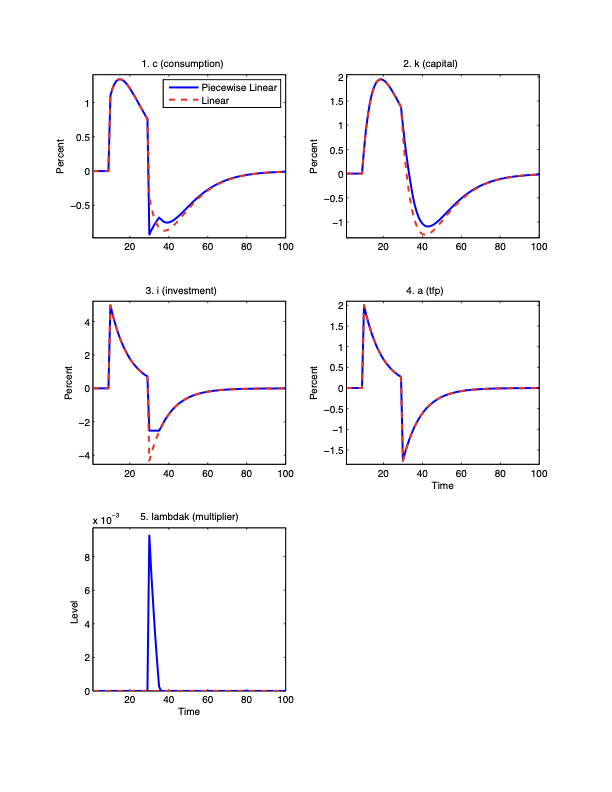
Impulse responses to a positive TFP shock at period 10 and a negative shock at period 30. Blue: piecewise-linear (OccBin). Red: linear (ignoring constraint). When investment is forced to its floor, the piecewise solution diverges sharply from the linear one.
The model is a standard RBC model with a capital adjustment cost
(PSI) and a Lagrange multiplier lambdak
on the investment floor. In the reference regime
(constraint not binding), the multiplier is zero: lambdak = 0.
In the alternative regime (constraint binding),
investment is pegged to its lower bound:
i = log(PHII · ISS).
The occasionally binding constraint is It ≥ φ · Iss, or in log-deviation form: ĩt ≥ log(φ). The constraint is violated — and regime switches — when the linear solution produces investment below this floor.
Variables in both .mod files:
| Variable | Description |
|---|---|
| a | Total factor productivity (log) |
| c | Consumption (log) |
| i | Investment (log) |
| k | Capital (log, end of period) |
| kprev | Lagged capital, defined as k(-1) |
| lambdak | Lagrange multiplier on the investment floor |
.mod files
The reference file dynrbc.mod sets
lambdak = 0 (equation 4 below). The alternative
file dynrbcirr_i.mod is an exact replica except
that equation 4 is replaced by
i = log(PHII · ziss), enforcing
the investment floor. All other equations and the parameter list
are identical.
// dynrbc.mod — reference regime (constraint not binding)
var a, c, i, k, kprev, lambdak;
varexo erra;
parameters ALPHA, DELTAK, BETA, GAMMAC, RHOA, PHII, PHIK, PSI, PSINEG, ISS, KSS;
model;
// 1. Euler equation (capital)
-exp(c)^(-GAMMAC)*(1+2*PSI*(exp(k)/exp(k(-1))-1)/exp(k(-1)))
+ BETA*exp(c(1))^(-GAMMAC)*((1-DELTAK)
-2*PSI*(exp(k(1))/exp(k)-1)*(-exp(k(1))/exp(k)^2)
+ALPHA*exp(a(1))*exp(k)^(ALPHA-1))
= -lambdak + BETA*(1-DELTAK+PHIK)*lambdak(1);
// 2. Resource constraint
exp(c)+exp(k)-(1-DELTAK)*exp(k(-1))+PSI*(exp(k)/exp(k(-1))-1)^2
= exp(a)*exp(k(-1))^ALPHA;
// 3. Investment definition
exp(i) = exp(k)-(1-DELTAK)*exp(k(-1));
// 4. Reference regime: multiplier is zero
lambdak = 0;
// 5. TFP process
a = RHOA*a(-1) + erra;
kprev = k(-1);
end;
// dynrbcirr_i.mod — alternative regime (investment at floor)
// Identical to dynrbc.mod except equation 4:
// 4. Alternative regime: investment is pinned to its lower bound
i = log(PHII*ziss);
var, varexo,
and parameters declaration must appear in the same order
in both files. Only the binding-regime equation changes.
Parameter values are set in paramfile_dynrbc.m,
loaded by the Dynare steady-state file at parse time.
BETA = 0.96; % discount factor
ALPHA = 0.33; % capital share
DELTAK = 0.10; % depreciation rate
GAMMAC = 2; % inverse elasticity of substitution
RHOA = 0.9; % TFP persistence
PHII = 0.975; % investment floor as fraction of I_ss
PSI = 0; % capital adjustment cost (zero here)
The toolkit computes steady-state capital and investment from these primitives: Kss = ((1/β − 1 + δ) / α)1/(α−1), Iss = δ Kss.
The script runsim_irrcap.m specifies the shock
sequence and calls solve_one_constraint. Here,
a positive 2% TFP shock hits at period 10 and a symmetric
negative shock at period 30, over a 100-period horizon.
clear
global M_ oo_
modnam = 'dynrbc'; % reference regime .mod file
modnamstar = 'dynrbcirr_i'; % alternative regime .mod file
% Constraint string (in deviation from steady state)
constraint = 'i<log(PHII)'; % switch to alt. regime when i hits floor
constraint_relax = 'lambdak<0'; % return to ref. regime when multiplier goes negative
irfshock = char('erra'); % TFP innovation
shockssequence = zeros(60,1);
shockssequence(10) = 0.02; % positive shock at period 10
shockssequence(30) = -0.02; % negative shock at period 30
nperiods = 100;
maxiter = 10;
[zdatalinear, zdatapiecewise, zdatass, oobase_, Mbase_] = ...
solve_one_constraint(modnam, modnamstar, ...
constraint, constraint_relax, ...
shockssequence, irfshock, nperiods, maxiter);
After the solver returns, the script unpacks the output arrays
into named workspace variables using a loop over the endogenous
variable list, then calls makechart to plot
piecewise-linear and linear paths side by side.
% Unpack all endogenous variables from the output matrices
for i = 1:Mbase_.endo_nbr
eval([Mbase_.endo_names{i}, '_l = zdatalinear(:,i);']);
eval([Mbase_.endo_names{i}, '_p = zdatapiecewise(:,i);']);
eval([Mbase_.endo_names{i}, '_ss = zdatass(i);']);
end
% Build chart inputs
titlelist = char('c (consumption)','k (capital)','i (investment)', ...
'a (tfp)','lambdak (multiplier)');
ylabels = char('Percent','Percent','Percent','Percent','Level');
legendlist = cellstr(char('Piecewise Linear','Linear'));
line1 = 100*[c_p, k_p, i_p, a_p, (lambdak_p + lambdak_ss)/100];
line2 = 100*[c_l, k_l, i_l, a_l, (lambdak_l + lambdak_ss)/100];
makechart(titlelist, legendlist, '', ylabels, line1, line2)
lambdak turns positive during the
binding episodes, signalling that the constraint is active.
All source code, model examples, and pre-generated output files are packaged in a single zip archive.
⇓ occbin_06162026.zip
Contains: toolkit_files/ · nine model examples · Dynare 6.5 & 7.0 compatible